Unit 1 · Present and past
Present continuous (I am doing)
Study
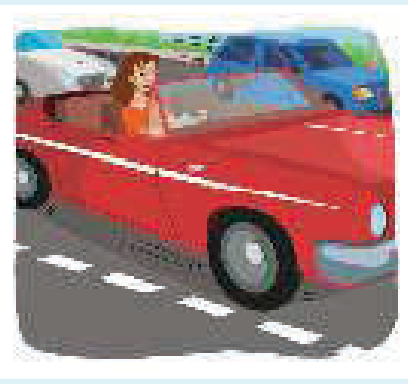
Sarah is in her car. She is on her way to work.
She's driving to work. (= She is driving …)
This means: she is driving now, at the time of speaking. The action is not finished.
am / is / are + -ing is the present continuous:
| I | am | (= I'm) |
| he / she / it | is | (= he's etc.) |
| we / you / they | are | (= we're etc.) |
+ driving / working / doing etc.
Study this example situation: Steve is talking to a friend on the phone. He says:

I'm reading a really good book at the moment. It's about a man who …
Steve says 'I'm reading …' but he is not reading the book at the time of speaking. He means that he has started reading the book, but has not finished it yet. He is in the middle of reading it.
I am doing something = I started doing it and I haven't finished; I'm in the middle of doing it.
Please don't make so much noise. I'm trying to work. (not I try)
'Where's Mark?' 'He's having a shower.' (not He has a shower)
Let's go out now. It isn't raining any more. (not It doesn't rain)
How's your new job? Are you enjoying it?
Sometimes the action is not happening at the time of speaking. For example:
Kate wants to work in Italy, so she's learning Italian.
(but perhaps she isn't learning Italian at the time of speaking)
Some friends of mine are building their own house. They hope to finish it next summer.
You can use the present continuous with today / this week / this year etc. (periods around now):
You're working hard today. (not You work hard today)
The company I work for isn't doing so well this year.
We use the present continuous when we talk about a change that has started to happen. We often use these verbs in this way:
| getting, becoming | changing, improving |
| starting, beginning | increasing, rising, falling, growing |
Is your English getting better? (not Does your English get better)
The population of the world is increasing very fast. (not increases)
At first I didn't like my job, but I'm starting to enjoy it now. (not I start)
→ Present continuous and present simple: Units 3–4 · Present tenses for the future: Unit 19
Exercises (4)
What's happening in the pictures? Choose from these verbs.
- 1
 She a picture.example
 - 2
 He a shoelace.
 - 3
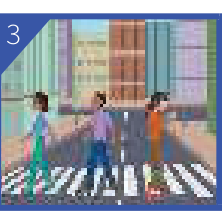 the road.
 - 4
 his head.
 - 5
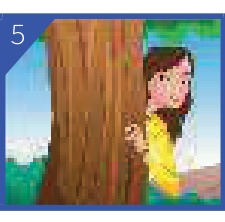 behind a tree.
 - 6
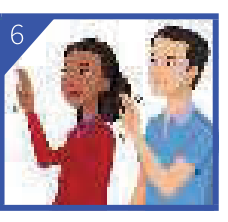 to somebody.
The sentences on the right follow those on the left. Which sentence goes with which?
- 1Please don't make so much noise.
- 2We need to leave soon.
- 3I don't have anywhere to live right now.
- 4I need to eat something soon.
- 5They don't need their car any more.
- 6Things are not so good at work.
- 7It isn't true what they say.
- 8We're going to get wet.
- aI'm getting hungry.
- bThey're lying.
- cIt's starting to rain.
- dThey're trying to sell it.
- eIt's getting late.
- fI'm trying to work.
- gI'm staying with friends.
- hThe company is losing money.
Write questions. Use the present continuous.
- 1What's all that noise?(what / happen?)example
- 2What's the matter?(why / you / cry?)
- 3Where's your mother?(she / work / today?)
- 4I haven't seen you for ages.(what / you / do / these days?)
- 5Amy is a student.(what / she / study?)
- 6Who are those people?(what / they / do?)
- 7I heard you started a new job.(you / enjoy / it?)
- 8We're not in a hurry.(why / you / walk / so fast?)
Put the verb into the correct form, positive (I'm doing etc.) or negative (I'm not doing etc.).
- 1Please don't make so much noise. (I / try) to work.example
- 2Let's go out now. (it / rain) any more.example
- 3You can turn off the radio. (I / listen) to it.
- 4Kate phoned last night. She's on holiday with friends. (She / have) a great time and doesn't want to come back.
- 5Andrew started evening classes recently. (He / learn) Japanese.
- 6Paul and Sarah have had an argument and now (they / speak) to one another.
- 7The situation is already very bad and now (it / get) worse.
- 8Tim (work) today. He's taken the day off.
- 9(I / look) for Sophie. Do you know where she is?
- 10The washing machine has been repaired. (It / work) now.
- 11(They / build) a new hospital. It will be finished next year.
- 12Ben is a student, but he's not very happy. (He / enjoy) his course.
- 13(The weather / change). Look at those clouds. I think it's going to rain.
- 14Dan has been in the same job for a long time. (He / start) to get bored with it.